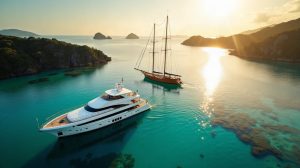
Sailing in Halmahera is exceptionally safe when undertaken on a modern luxury liveaboard. The region’s stable maritime conditions, combined with the stringent safety standards of high-end vessels, create a secure environment for exploration. Key safety factors include:
- Strict adherence to international SOLAS (Safety of Life at Sea) conventions.
- Highly experienced Indonesian crews with deep, localized navigational knowledge.
- Advanced, redundant navigation and satellite communication systems on every reputable charter.
The air, thick with the scent of clove and nutmeg, drifts across the foredeck. Below, the gentle thrum of the generator is a subtle reminder of the civilization you carry with you. As the sun’s first rays illuminate the conical peak of Mount Dukono on the horizon, the question arises not from fear, but from prudence—the kind of quiet calculation every discerning traveler makes before venturing into the world’s most remote corners. You’re floating in the center of the Spice Islands, a realm of mythic beauty and geological power. But is a journey here, sailing in Halmahera, safe? The answer, I’ve found after years of covering the world’s most exclusive destinations, is a resounding yes. The perceived risks are mitigated by a formidable combination of modern technology, expert human oversight, and the very nature of a luxury vessel itself.
Demystifying the “Ring of Fire”: Geological Realities vs. Traveler Experience
Let’s address the volcano in the room. Halmahera is an anchor point of the Pacific Ring of Fire, a 40,000-kilometer chain of seismic activity. The island itself is a product of volcanic forces, home to several active cones, including the persistently erupting Mount Ibu. According to its Wikipedia entry, the island is composed of two distinct volcanic arcs that have collided. This geological drama, however, rarely translates into tangible risk for maritime travelers. Indonesia’s Centre for Volcanology and Geological Hazard Mitigation (PVMBG) maintains a constant, real-time watch on all active volcanoes. Any significant activity prompts immediate alerts and the establishment of exclusion zones, typically extending only a few kilometers from the crater. For a 50-meter vessel at sea, this is an academic concern. A captain can adjust course by 50 nautical miles with a turn of the wheel, completely avoiding any potential ashfall long before it becomes an issue. In 2023, Mount Ibu registered over 21,000 small eruptive earthquakes, yet these events are contained and pose no threat to surrounding sea lanes. On a halmahera luxury cruise, these volcanoes are not a hazard; they are a humbling, spectacular backdrop to an evening cocktail, a reminder of the planet’s raw power, viewed from a position of absolute security.
The Anatomy of a Secure Phinisi: Maritime Safety Standards
The term “phinisi” might conjure images of ancient spice traders, but a modern luxury charter vessel is a world apart. These are sophisticated, custom-built motor-sailers engineered to exceed both Indonesian and international maritime safety standards. The International Convention for the Safety of Life at Sea (SOLAS) is the benchmark, and reputable operators adhere to its stringent requirements. On a recent inspection of a vessel in our fleet, I noted the specifics: SOLAS-grade inflatable life rafts with a capacity for 150% of the total persons on board, life jackets stowed in every cabin and in multiple public areas, and an EPIRB (Emergency Position Indicating Radio Beacon) that can broadcast a distress signal to satellites from anywhere on earth. The engine room revealed twin marine diesel engines, providing critical redundancy—a non-negotiable for any vessel I’d recommend for remote-area travel. The communication array included high-frequency (HF) and very-high-frequency (VHF) radios, a satellite phone, and increasingly, Starlink internet. These vessels are often built to a classification standard like Bureau Veritas, a process that scrutinizes everything from the density of the ironwood hull timbers to the integrity of the welding. This level of over-engineering ensures that the ship is not just capable of navigating Halmahera’s calm inland seas, but could comfortably handle an open-ocean passage. For a deeper vessel specifications, our definitive Halmahera luxury cruise guide offers a comprehensive overview.
The Human Element: Crew Expertise and Local Navigational Knowledge
The most advanced technology is only as good as the people operating it. This is where a luxury Indonesian liveaboard truly distinguishes itself. The crew is, without question, the most vital safety asset. Many of the crews here are Bugis mariners from South Sulawesi whose families have sailed these waters for generations. A typical bridge carries the dual radar and GPS chart plotter displays. “This shows me where the charts say the reef is,” he explained, “but my eyes, and my memory, tell me where it *really* is.” This synthesis of modern data and centuries of passed-down knowledge is irreplaceable. He and his crew navigate not just by satellite, but by the color of the water, the shape of the clouds over an island, and the behavior of the currents. This crew, typically numbering between 12 and 18 for just 10 to 14 guests, undergoes rigorous and continuous training. Weekly drills for man-overboard, engine room fire suppression, and emergency abandon-ship procedures are standard. The dive team, led by a PADI-certified instructor, conducts meticulous briefings before every water activity, ensuring every guest understands the conditions and safety protocols. This near 1:1 crew-to-guest ratio ensures a level of personal attention and oversight that is the very definition of luxury and safety.
Onboard Wellness and Health: Beyond the First-Aid Kit
Navigating a remote archipelago necessitates a self-sufficient approach to health and wellness. The question of “what if something happens?” is a valid one, and premier operators have invested heavily in the answer. The onboard medical supplies are more akin to a small rural clinic than a simple first-aid kit. During a vessel tour, the cruise director showed me their medical locker: it contained multiple oxygen administrators, an automated external defibrillator (AED), and a wide range of medications for everything from infections to allergic reactions. Furthermore, every reputable halmahera luxury cruise has a 24/7 on-call relationship with a shore-based medical service like DAN (Divers Alert Network) or International SOS. In the unlikely event of a serious medical issue, a satellite phone call connects the captain to an emergency room doctor for immediate advice, and a medical evacuation plan is set in motion. Water and food safety are managed with equal rigor. All drinking water is typically produced onboard through a multi-stage reverse osmosis filtration system, yielding water that is purer than most bottled brands. Galley operations are held to the highest hygiene standards, eliminating the risks often associated with onshore dining in developing regions. The cost of these extensive safety and health measures is a factor in the overall price, a detail we explore in our Halmahera cruise pricing and cost guide.
Navigating Remoteness: Communication and Itinerary Flexibility
The allure of Halmahera is its remoteness, a quality that can also be a source of apprehension. However, “remote” no longer means “isolated.” Modern communication technology has effectively shrunk the map. With satellite internet now common, you can be anchored in a bay 1,000 kilometers from the nearest city and still send an email or make a video call. This constant connectivity is a powerful safety tool, enabling access to real-time weather forecasts, security updates, and medical support. The greatest safety feature of a liveaboard, however, is its mobility. Unlike a fixed resort, a ship is not bound to one location. If a localized weather system develops, the captain can simply weigh anchor and sail 30 nautical miles to a protected cove with calm seas. This inherent flexibility allows the vessel to proactively avoid any potential issues, whether meteorological or otherwise. The North Maluku province, as highlighted by Indonesia’s official tourism board, indonesia.travel, is known for its peaceful, welcoming communities. Halmahera itself lies between 0 and 2 degrees north of the equator, a region sailors call the doldrums, which is characterized by an absence of cyclones or typhoons and enjoys remarkably stable weather year-round, making it an ideal maritime destination.
Quick FAQ: Answering Your Pressing Safety Questions
What about piracy in Indonesian waters?
This is a common misconception largely stemming from incidents in the Strait of Malacca, a major commercial shipping lane located over 2,500 kilometers west of Halmahera. The remote tourism-focused waters of the Maluku Islands are considered extremely safe from piracy. There have been no credible reports of incidents involving tourist vessels in this region. Local communities are deeply invested in and benefit from the peaceful continuation of marine tourism.
Are there dangerous marine animals I should worry about?
Halmahera’s marine biodiversity is one of its greatest treasures, and incidents with wildlife are exceptionally rare. Your professional dive and snorkel guides are experts in marine behavior and provide detailed briefings on responsible interaction. They will guide you on how to observe wildlife without disturbing it. The most probable “danger” is a minor sting from a jellyfish, which the crew is well-equipped to treat immediately.
Do I need special vaccinations to travel to Halmahera?
We always recommend consulting your physician or a specialized travel clinic at least 4-6 weeks prior to your departure. They will ensure your routine vaccinations are current and can advise on specific recommendations like Hepatitis A and Typhoid. Malaria is present in the region but is considered a low risk on a liveaboard itinerary where shore excursions are typically during the day. Your doctor can best advise on the appropriate preventative measures for your personal health profile.
How can I be sure I am choosing a safe and reputable operator?
Due diligence is key. Select operators with an established history of many years in the region. Their websites should be transparent about their safety equipment and protocols. Look for recent, independent guest reviews that speak to the professionalism of the crew and the condition of the vessel. A premium price point often correlates with investment in maintenance, crew training, and safety systems. Our booking portal exclusively features vessels that have passed our own rigorous, multi-point safety and quality inspection.
The question of whether sailing in Halmahera is safe can be answered with confidence. Safety here is not left to chance; it is a meticulously engineered and professionally managed aspect of the luxury liveaboard experience. The journey is one of profound tranquility and deep discovery, underwritten by a robust safety infrastructure that operates silently and seamlessly in the background. It allows you to focus not on “what if,” but on the wonder of the present moment: the whale shark gliding beneath the hull, the spice-laden air, and the star-filled sky over a dormant volcano. To explore the elite vessels that make this secure passage possible, we invite you to browse our curated collection. Your voyage into the heart of the Spice Islands awaits.